

 Tiếng Việt
 中文 (Chinese)
 한국어
한국어 日本語
日本語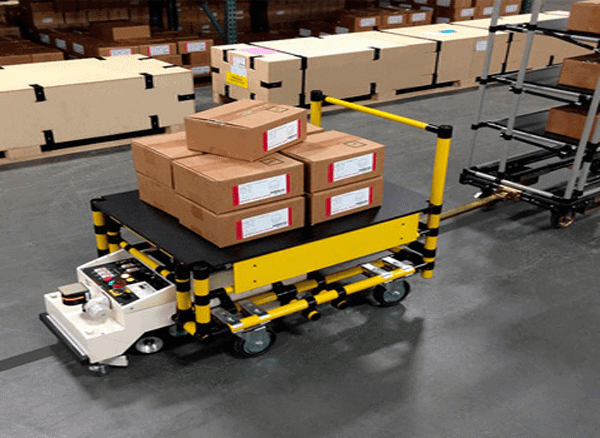
The perfect solution in warehouse 4.0 is the application of modern technologies aimed at reducing human effort and increasing work productivity. Among the prominent warehouse 4.0 solutions, AGV (Automated Guided Vehicle) cannot be overlooked. Join VietPOS Rack to learn about AGV technology, including its detailed structure, cost, applications, and more.
Liên hệ tư vấn và mua hàng
What is an AGV?
AGV stands for Automated Guided Vehicle. This type of vehicle uses navigation technology solutions to assist in transporting goods and materials in warehouses to pre-integrated locations. Thanks to its automatic transport feature, the AGV allows for almost complete elimination of human intervention in its operation.

AGV Autonomous Vehicle System in Warehouse
Structural Features
The AGV autonomous vehicle includes components such as: Pathfinding unit, Obstacle detection sensor, Anti-collision sensor, Driver and motor, Remote transceiver, Battery and charger, Central control unit, Cargo vehicle connection motor, Position sensor, User interface, Mechanical parts,…
1. Pathfinding Unit
– Free Path Navigation AGV: This type of vehicle offers high flexibility thanks to built-in gyroscopic sensors that determine the vehicle’s direction of movement. Laser sensors allow the detection of surrounding obstacles during movement. This enables the autonomous vehicle to easily move anywhere within the controlled range and find the shortest path. Using Free Path Navigation AGV incurs significant manufacturing costs and requires high technology.
– Fixed Path Navigation AGV: This type of vehicle uses magnetic field sensors, metal sensors, optical sensors, and follows pre-defined guide paths, including colored lines, magnetic tapes, rails, magnetic wires, etc. The AGV operates along a fixed axis; changing the direction of movement requires reconfiguring the control system. However, the investment cost for manufacturing Fixed Path Navigation AGV is lower than that of the free path navigation type.

The price of an AGV autonomous vehicle can range from tens of millions to hundreds of millions of VND.
2. Obstacle Detection Sensor
The motor is equipped to ensure safety during movement. Depending on the AGV’s configuration, you can use ultrasonic sensors, laser sensors, optical sensors, etc. The obstacle detection sensor can work from a distance to close range. When an obstacle is in these three zones, the autonomous vehicle will perform the following actions in sequence to ensure safety: warning, deceleration, braking.
3. Anti-Collision Sensor
The AGV system is equipped with a collision sensor that helps the device stop immediately upon impact during operation, minimizing incidents and ensuring safety when the vehicle moves.
4. Driver and Motor
Depending on the AGV model and the weight of the goods to be transported, the vehicle is equipped with 1 to 2 drivers. The driver and motor directly determine the motor voltage, power, and battery capacity.
5. Remote Transceiver
The remote transceiver helps transmit data from the control center during operation, enhancing the flexibility of the AGV system, allowing the vehicle to send and receive information from any location within the coverage area.
Depending on the machine model, the data transmission device will be an RF or Wi-Fi transceiver.

What are the components of an AGV?
6. AGV Battery and Charger
Batteries used for AGV systems are typically Lithium batteries, Lithium iron phosphate batteries – LIFE04, lead-acid batteries, dry batteries, etc.
7. Central Controller
The AGV’s central controller operates independently or in combination with multiple other vehicles, under the control of the operations center.
8. Towing Mechanism
As the name suggests, the towing mechanism connects to the cargo, and can be controlled automatically or manually.
9. Position Sensor
This device helps determine landmarks (pickup points, drop-off points, stop points, turn points, etc.), and also allows the control center to locate the vehicle on the movement map.
10. User Interface
Users can use the screen, button system, and indicator lights to control the AGV’s operation, display information about the machine’s status, and the vehicle’s position on the movement map. Meanwhile, control buttons help with emergency stops, job completion notifications, Auto/Manual switches, and status indicator lights.
11. Mechanical Components
The mechanical structure is a collection of chassis, wheels, body, mounting fixtures, etc., which determine the sturdiness and durable operation of the AGV in various industrial conditions.
How much does an AGV cost?
The price of an AGV depends on many different factors, including origin, features, and the needs of the business. Therefore, the price of an AGV can range from tens to hundreds of millions of VND.


Automation Guided Vehicle


Automation Guided Vehicle


Automation Guided Vehicle


Automation Guided Vehicle


Automation Guided Vehicle


Automation Guided Vehicle


Automation Guided Vehicle


Automation Guided Vehicle
How is AGV applied in warehouse management?
- Application in transporting heavy goods: Each AGV model will have different cargo carrying capacities, easily transporting heavy and bulky goods. Equipping AGV increases the versatility in a warehouse storing diverse goods.
- Application in moving goods in narrow aisles and high bays: With the above structural characteristics, AGVs are designed to be able to move in narrow spaces and allow for quick loading and unloading of goods.
- Picking and sorting goods: Thanks to connections with smart software, scanners, RFID devices, and sensors, AGVs can automatically collect necessary information to complete the picking and sorting of goods in the warehouse instead of requiring a lot of human labor to move between picking locations, helping to fulfill orders quickly.

AGV autonomous vehicles are widely used in warehouse management
