

 Tiếng Việt
 中文 (Chinese)
 한국어
 日本語

.bp-product-grid .bp-product h4 a{color:#1e293b;text-decoration:none}
.bp-product-grid .bp-product .bp-price{color:#dc2626;font-weight:bold;font-size:13px;margin-bottom:6px}
.bp-product-grid .bp-product .bp-btn{display:block;text-align:center;background:#2563eb;color:#fff;padding:6px 8px;border-radius:4px;text-decoration:none;font-size:12px;margin-top:auto}
.bp-stats{display:grid;grid-template-columns:repeat(auto-fit,minmax(160px,1fr));gap:14px;margin:24px 0;text-align:center}
.bp-stats > div{background:#f8fafc;border-radius:8px;padding:18px 12px;border:1px solid #e2e8f0}
.bp-stats .bp-stat-num{font-size:32px;font-weight:bold;color:#2563eb;line-height:1.1;margin-bottom:4px}
.bp-stats .bp-stat-label{font-size:13px;color:#475569}
.bp-customer-box{background:#f1f5f9;border-radius:8px;padding:16px 20px;margin:20px 0;border-left:4px solid #475569}
.bp-customer-box strong{color:#1e293b}
.bp-testimonial{background:#fef9e7;border-left:4px solid #f59e0b;padding:20px 24px;margin:28px 0;border-radius:6px;font-style:italic;color:#78350f;font-size:16px;line-height:1.6}
.bp-testimonial cite{display:block;margin-top:12px;font-style:normal;color:#92400e;font-size:13px;font-weight:600}
.bp-verdict-box{background:#dcfce7;border-left:4px solid #16a34a;padding:14px 18px;margin:16px 0;border-radius:6px;color:#14532d}
.bp-verdict-box strong{color:#15803d}
.bp-coverage-table{width:100%;border-collapse:collapse;margin:24px 0;font-size:14px}
.bp-coverage-table th{background:#475569;color:#fff;padding:10px;text-align:left}
.bp-coverage-table td{padding:9px 10px;border-bottom:1px solid #e2e8f0}
.bp-policy-grid{display:grid;grid-template-columns:repeat(auto-fit,minmax(220px,1fr));gap:14px;margin:24px 0}
.bp-policy-grid > div{background:#f0f9ff;border:1px solid #bae6fd;border-radius:8px;padding:16px}
.bp-policy-grid h4{margin:0 0 8px;color:#0c4a6e}
.bp-policy-grid p{margin:0;color:#0369a1;font-size:14px}
.bp-glossary{width:100%;border-collapse:collapse;margin:20px 0;font-size:14px}
.bp-glossary th{background:#f1f5f9;color:#1e293b;padding:10px;text-align:left}
.bp-glossary td{padding:10px;border-bottom:1px solid #e2e8f0;vertical-align:top}
.bp-glossary tr:nth-child(even) td{background:#fafafa}
.bp-tldr{background:#f0f9ff;border:1px solid #bae6fd;border-radius:10px;padding:16px 20px;margin:20px 0 28px}
.bp-tldr-label{display:block;font-size:12px;font-weight:700;letter-spacing:.04em;text-transform:uppercase;color:#0369a1;margin-bottom:6px}
.bp-tldr p{margin:0;color:#0c4a6e;font-size:15px;line-height:1.6}
.bp-toc{background:#f8fafc;border:1px solid #e2e8f0;border-radius:10px;padding:16px 22px;margin:20px 0 28px}
.bp-toc-title{margin:0 0 8px;font-size:13px;font-weight:700;letter-spacing:.03em;text-transform:uppercase;color:#1e293b}
.bp-toc ul{margin:0;padding-left:20px;columns:1}
.bp-toc li{margin:4px 0}
.bp-toc a{color:#2563eb;text-decoration:none;font-size:14px}
.bp-toc a:hover{text-decoration:underline}.bp-stat-callout{background:linear-gradient(135deg,#1e293b 0%,#334155 100%);color:#fff;border-radius:10px;padding:22px 26px;margin:24px 0;text-align:center}
.bp-stat-callout .bp-stat-callout-num{font-size:40px;font-weight:800;line-height:1.1;color:#7dd3fc}
.bp-stat-callout .bp-stat-callout-label{font-size:14px;color:#cbd5e1;margin-top:6px}
.bp-hero{margin:0 0 28px;text-align:center}
.bp-hero img{width:100%;border-radius:12px;display:block;aspect-ratio:16/9;object-fit:cover}
.bp-inline-img{margin:24px 0;text-align:center}
.bp-inline-img img{width:100%;border-radius:8px;display:block;aspect-ratio:16/9;object-fit:cover}
.bp-inline-img figcaption{font-size:13px;color:#64748b;margin-top:8px;font-style:italic}
Calculating the number of document shelving units for an archive storage facility is a three-layer conversion problem: from the actual number of record boxes to linear meters of shelving, from linear meters to the number of shelving units, and from the number of shelving units to the warehouse floor area that needs to be leased or built. This conversion is not only for purchasing enough shelving, but also for determining the scale of the paper document warehouse under Article 9 of Decree 113/2025 and the minimum floor area under point a, clause 2, Article 10 of Decree 113/2025 — two legal bases against which the archive storage cost estimates of businesses and agencies are currently commonly cross-checked.
To calculate the number of document shelving units: take the total number of record boxes and divide by the number of boxes that fit per linear meter of shelving (about 8 boxes/meter with TCVN 9252 boxes placed upright in 400 mm deep shelving) to get the number of linear meters; then divide by 6 linear meters per shelving unit to get the number of units. The minimum warehouse floor area under point a, clause 2, Article 10 of Decree 113/2025 equals 1/5 of the total linear meters of shelving. For example, 2,400 boxes ≈ 300 linear meters ≈ 50 single-sided shelving units and a minimum floor area of 60 m², excluding aisles and working areas.
What is a linear meter of records and why is archive storage estimated by linear meter?
A linear meter is a unit for measuring the volume of records by the length of the shelving on which they are placed: 1 linear meter corresponds to 1 meter of shelf length loaded with record boxes. This unit is used instead of the number of boxes or pages because it is directly tied to the materials to be purchased (shelving) and to the floor area to be allocated, and it is also the unit that Decree 113/2025 uses to classify the scale of paper records storage.
In practice, when preparing estimates, the same records storage can be described in three ways: “about 2,400 boxes”, “300 linear meters”, or “50 shelves”. These three ways do not replace one another but complement one another. The number of boxes is used for inventory and packing; the number of linear meters is used to compare scale under Decree 113/2025; the number of shelves is used for ordering and floor layout. If you stop at the number of boxes, the unit may easily buy too few shelves or rent excess floor space; if you stop at the number of shelves without converting to linear meters, the estimate will be difficult to compare with the scale levels in the legal document.
Specifications of TCVN 9252 record boxes and the archive shelving needed for the calculation
Viet POS Rack archive document shelf
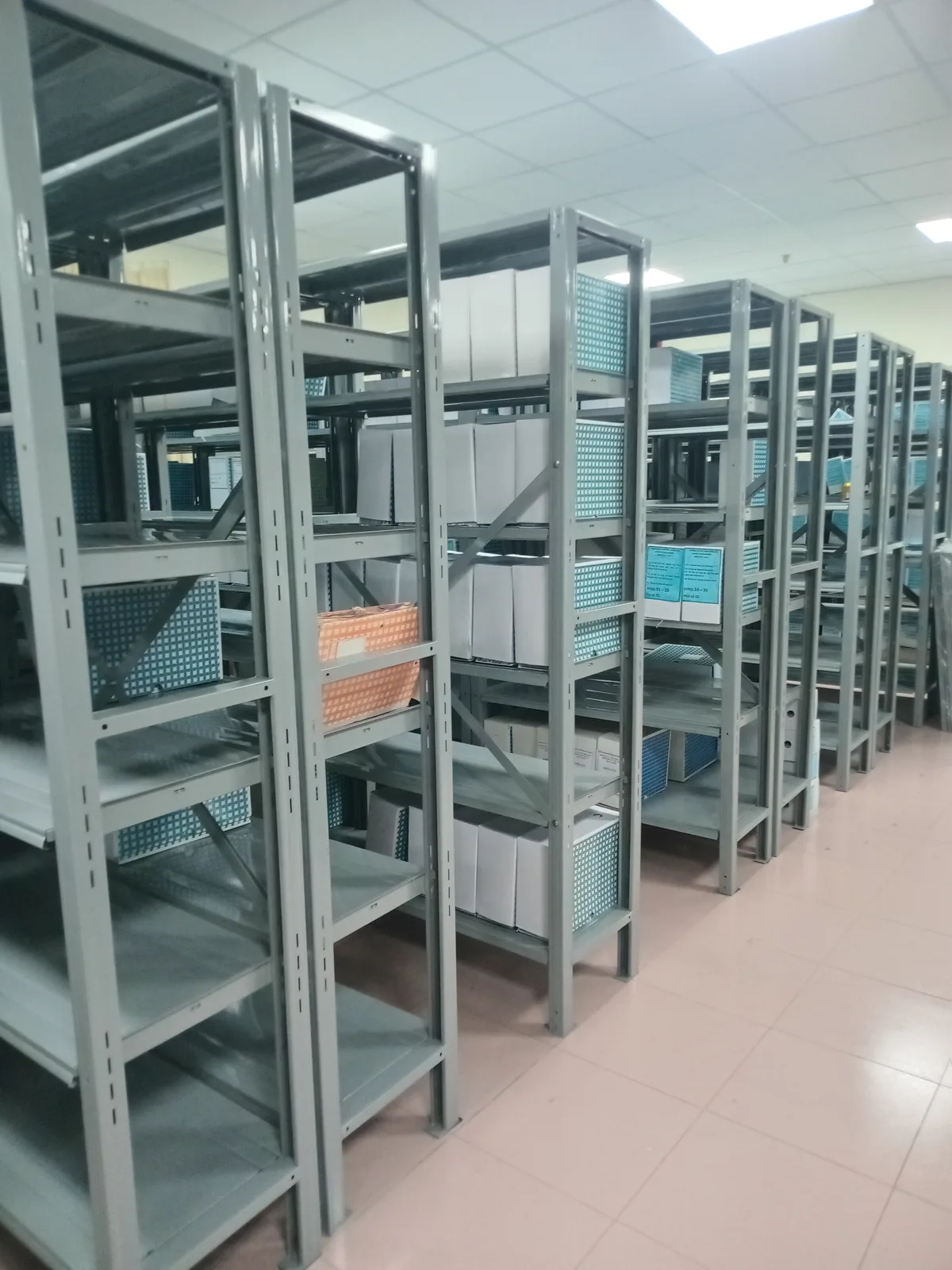
The calculation is only accurate when using the correct two original parameters: the dimensions of the record box according to TCVN 9252 (depth 350 mm, height 250 mm, spine 125 mm) and the dimensions of the actual document shelf to be installed. With a 1090 × 400 × 2000 mm shelf, a 1000 mm bay interior and 6 shelves, the number of boxes each bay holds is derived from the shelf depth and height, not from the bay width.
Record box dimensions according to TCVN 9252
The paper archive document storage box according to TCVN 9252 has a depth of 350 mm, a height of 250 mm and a box spine of 125 mm. How the box is placed determines the entire calculation: the box is placed upright, with the spine facing outward, so that the records officer can read the record label without pulling out the whole box. When placed upright, the depth occupying space on the shelf is 350 mm and the width occupying space along the shelf is 125 mm (spine thickness). This is why a 400 mm deep shelf is the appropriate level: the 350 mm depth of the box plus some handling clearance at the front and a ventilation gap at the back.
Archive document shelf dimensions used in the example
The archive document shelf by Viet POS Rack (manufactured by Viet Duc Tri Group) has dimensions of 1090 × 400 × 2000 mm (length × depth × height), a 1000 mm bay interior, 6 shelves. The 1090 mm length includes the side frame and the 1000 mm bay interior; the 400 mm depth is sufficient for the TCVN 9252 box placed upright; the 2000 mm height with 6 shelves allows even tier division and still remains within normal handling reach. The tier spacing between shelves is chosen according to the 250 mm box height plus handling clearance, so each shelf holds one layer of upright boxes.
When comparing with other types of shelves on the market, note that the 1230 mm shelf size is not the same module as the TCVN 9252 box and should not be mixed within the same calculation. The comparison should only be made using the same set of box parameters and the same box arrangement style; if the unit already has shelves of a different module, each row should be calculated separately.
Formula for estimating the number of record boxes per meter of shelving
The number of boxes per meter of shelving is estimated by dividing the inner compartment length by the box spine thickness, rounding down, and multiplying by the actual number of shelves loaded. With a 1000 mm inner compartment and a 125 mm box spine, each tier holds 8 boxes; with 6 shelves, each compartment holds about 48 boxes, equivalent to about 8 boxes per meter of shelving. This is an estimate and must be discounted for variations in box thickness and for handling clearance.
- Step 1 — Determine the actual box spine thickness. Use the TCVN 9252 box with a 125 mm spine as the standard; if the actual box is thicker due to a larger file, record it for recalculation.
- Step 2 — Calculate the number of boxes per tier. Take the 1000 mm inner compartment length divided by 125 mm, rounded down to 8 boxes per tier.
- Step 3 — Multiply by the actual number of shelves loaded. A 6-shelf unit but usually the top or bottom shelf is left clear for handling; if all 6 shelves are loaded, each compartment holds about 48 boxes.
- Step 4 — Convert to meters of shelving. Each 1000 mm compartment is equivalent to 1 meter of shelving; thus about 8 boxes per meter of shelving is the figure used for quick estimation.
- Step 5 — Apply a discount. Deduct 5–10% for boxes thicker than standard, for gaps, and for shelves not fully loaded; state clearly in the estimate that this is an estimated figure.
If the files are not yet boxed, an estimate can be made in reverse from the number of pages or the number of file pairs, but the error will be much larger than counting boxes. For budget files, it is advisable to finalize based on the actual number of boxes or on the meters of shelving approved by the competent authority.
How to calculate the number of shelving units from meters of shelving: single-sided and back-to-back double shelving
The number of single-sided shelving units equals the total meters of shelving divided by the meters of shelving per unit. With a 1090 × 400 × 2000 mm unit having a 1000 mm inner compartment and 6 shelves, each single-sided unit is equivalent to about 6 meters of shelving. When two units are joined back-to-back into a double row, the same meters of shelving require fewer aisles, saving floor area.
The compartment division must be finalized before ordering, because it affects the number of side frames and the number of shelves. With a 1090 mm long unit, each 1000 mm compartment is one module; if the organization wants more compartments in the same row, it should order multi-compartment units instead of joining multiple single units, to reduce the number of side frames and make better use of space.
- Single-sided shelving: suitable when placed against a wall or in the middle of an aisle with one side; each unit is about 6 meters of shelving.
- Back-to-back double row: two units joined back-to-back, saving one aisle and one layer of frame; the same meters of shelving but fewer single units and less floor area.
- Multi-compartment row: multiple 1000 mm modules joined on the same pair of side frames; suitable for long warehouses, reducing the number of frames and installation time.
When arranging, it is necessary to leave operating aisles between rows and a main aisle for transporting boxes. Aisles are not counted in shelf meters but occupy floor area, so they must be added when renting or building a warehouse. For high-density warehouses, mobile filing cabinets (compactors) can be considered to reduce fixed aisles, but the cost and the actual floor load capacity of the building must be balanced.
Scale of paper document warehouses according to Article 9 of Decree 113/2025
Article 9 of Decree 113/2025 classifies the scale of paper document warehouses by shelf meters: Level 1 under 3,000 shelf meters; Level 2 from 3,000 to under 6,000 shelf meters; Level 3 from 6,000 shelf meters and above. Correctly determining the level decides the requirements for infrastructure, personnel and preservation regime, so the number of shelf meters must be finalized before preparing the investment estimate.
These three levels show that the boundaries of 3,000 and 6,000 shelf meters are thresholds requiring special attention. A warehouse at 2,900 shelf meters, if it receives a few hundred more document boxes, will move from Level 1 to Level 2; therefore, when calculating the number of shelves, capacity should be reserved for the next phase, avoiding having to upgrade infrastructure right after installing shelves. For units planning to receive records transferred from many units, the high scenario should be used to select the shelf configuration and warehouse area.
Minimum warehouse floor area according to point a clause 2 Article 10 of Decree 113/2025
Point a clause 2 Article 10 of Decree 113/2025 stipulates that the minimum floor area of a paper document preservation warehouse equals one fifth of the total number of shelf meters to be preserved. That means for every 5 shelf meters, at least 1 m² of floor is required. This is the minimum floor level under the regulations, not yet including wide aisles, working areas and reserve space.
For example, with 1,000 shelf meters, the minimum floor area is 200 m². With 2,400 document boxes, equivalent to about 300 shelf meters, the minimum floor area is 60 m². This figure is very small compared with actual needs because aisles, boxing areas, inventory areas and safety distances are not included. When preparing estimates for renting or building a warehouse, the minimum level under Decree 113/2025 should be used as the legal floor, then operating area should be added according to the actual shelf layout.
Full calculation example: how many shelves and how many floor meters are needed for 2,400 document boxes?
With 2,400 document boxes and an estimate of 8 boxes per shelf meter, the total number of shelf meters is about 300. Divided by 6 shelf meters per single-sided shelf, about 50 shelves are needed. The minimum floor area according to point a clause 2 Article 10 of Decree 113/2025 is 300 divided by 5, i.e. 60 m²; the area of aisles and operating areas should be added before finalizing the plan to rent or build a warehouse.
| Step | Formula / calculation method | Result with 2,400 boxes |
|---|---|---|
| Number of boxes per shelf meter | 1000 mm compartment depth ÷ 125 mm box spine, rounded down | 8 boxes/shelf meter (estimate) |
| Total shelf meters | Number of boxes ÷ boxes per shelf meter | 2,400 ÷ 8 = 300 shelf meters |
| Number of single-sided shelving units | Shelf meters ÷ 6 shelf meters per unit | 300 ÷ 6 = 50 units |
| Minimum floor area | Shelf meters ÷ 5 (Point a, Clause 2, Article 10 of Decree 113/2025) | 300 ÷ 5 = 60 m² |
| Operating area | Plus aisles, boxing area, inventory area | Depends on actual layout |
If switched to back-to-back double rows, the number of shelving frames decreases and the floor area for the same 300 shelf meters also decreases, because each pair of shelving units only needs one aisle in front instead of two. However, the aisle width and the opening direction of the boxes need to be rechecked so as not to affect operations. For warehouses with limited area, mobile filing cabinets (compactors) are the next option to consider, after optimizing with double rows and multi-bay rows.
To finalize the plan, the unit should prepare three pieces of information: the total number of boxes or expected shelf meters, the existing warehouse floor plan, and requirements for aisles and working areas. These three pieces of information are enough to arrange shelving and provide a quote without multiple site surveys.
Summary table of terms and parameters used in the calculation
The table below summarizes the terms and parameters needed when calculating the number of document shelving units, with examples for quick cross-checking when preparing estimates. The figures for boxes and shelving units are technical parameters; the figures for scale and floor area are legal regulations that must cite the correct article and clause.
| Term / parameter | Definition / value | Application example |
|---|---|---|
| Shelf meter | Unit measuring document volume by the length of the shelf holding documents | 300 shelf meters corresponds to 2,400 boxes (estimated) |
| TCVN 9252 record box | 350 mm deep, 250 mm high, 125 mm spine; placed upright, spine facing outward | Each 1000 mm bay level holds 8 boxes |
| Archive document shelving | 1090 × 400 × 2000 mm, 1000 mm bay interior, 6 shelves | Each single-sided unit is about 6 shelf meters |
| Scale of paper document warehouse | Article 9 of Decree 113/2025: Level 1 under 3,000 shelf meters; Level 2 from 3,000 to under 6,000; Level 3 from 6,000 and above | 300 shelf meters falls under Level 1 |
| Minimum floor area | Point a, Clause 2, Article 10 of Decree 113/2025: equal to 1/5 of total shelf meters | 300 shelf meters → 60 m² |
Common mistakes when calculating the number of record storage shelving units
The most common mistake is calculating by number of pages or number of record pairs instead of number of boxes, leading to large errors when ordering shelving. The second mistake is omitting aisles and operating areas, so that after renting the warehouse there is not enough space to work. The third mistake is mixing shelving sizes of a different module with TCVN 9252 boxes in the same calculation.
- Calculating by number of pages or number of file pairs: large error margin because file thickness varies; should finalize based on actual number of boxes or approved shelf meters.
- Ignoring aisles and operating areas: the minimum floor area under Decree 113/2025 is only the legal floor level, not sufficient for actual operations.
- Mixing shelf sizes of different modules: 1230 mm shelves are not the same module as TCVN 9252 boxes; mixing them will cause errors in shelf meters and shelf counts.
- No capacity reserve: warehouses near the 3,000 or 6,000 shelf-meter threshold may shift to a different scale level when receiving additional files, leading to higher infrastructure requirements.
- Not clearly stating estimates: budget documents need to clearly show the method and deduction factors for appraisal agencies to cross-check.
To avoid the above mistakes, a simple spreadsheet should be set up including: number of boxes, boxes per shelf meter, total shelf meters, number of shelves, minimum floor area, and operating area. Each row should clearly state the data source and note “estimate” on rows with deductions. This approach makes budget documents transparent and easy to cross-check with Article 9 and Article 10 of Decree 113/2025.
Frequently asked questions
How many file boxes can 1 shelf meter hold?
With TCVN 9252 boxes placed upright in a 400 mm deep shelf, a 1000 mm compartment can hold 8 boxes per tier based on 125 mm spine thickness. If all 6 tiers are filled, each compartment holds about 48 boxes, equivalent to about 8 boxes per shelf meter. This is an estimate; thicker boxes or incomplete packing will reduce the number of boxes per shelf meter, so a 5–10% deduction should be applied when preparing the budget.
How many shelf meters can a 1090 × 400 × 2000 mm file shelf hold?
The shelf has a 1000 mm compartment and 6 tiers, so each single-sided shelf is equivalent to about 6 shelf meters. When two shelves are joined back-to-back into a double row, the same number of shelf meters requires fewer aisles, saving floor area. If multiple 1000 mm modules are joined on the same pair of side frames, the number of shelf meters increases with the number of compartments.
How is the minimum warehouse floor area calculated?
Under point a, clause 2, Article 10 of Decree 113/2025, the minimum floor area of a paper document storage warehouse equals one-fifth of the total number of shelf meters to be stored. For example, 1,000 shelf meters require a minimum of 200 m²; 300 shelf meters require a minimum of 60 m². This is the legal floor level and does not include aisles, work areas, and reserve space.
How are paper document warehouse scales classified?
Under Article 9 of Decree 113/2025, Level 1 is under 3,000 shelf meters; Level 2 is from 3,000 to under 6,000 shelf meters; Level 3 is from 6,000 shelf meters and above. Correctly determining the level decides infrastructure and preservation regime requirements, so the number of shelf meters should be finalized before preparing the investment budget.
Should mobile filing cabinets be used instead of fixed shelves?
Mobile compactor shelving is suitable when warehouse space is limited and fixed aisles need to be reduced. However, costs, the building’s actual floor load capacity, and operational needs must be balanced. For new warehouses or warehouses with sufficiently large floor areas, fixed shelving arranged in back-to-back double rows is often a more cost-effective option.
What information is needed to arrange shelving and provide a quote?
You should provide the total number of file boxes or the estimated number of shelf meters, the existing warehouse floor plan drawing, and requirements for aisles and work areas. These three pieces of information are sufficient to arrange shelving and provide a quote without multiple site surveys. If shelf meters have already been calculated according to an approved budget estimate, they should be sent along for cross-checking.
Are you preparing a budget for a records storage warehouse? Send the total number of boxes or the estimated number of shelf meters along with the warehouse floor plan drawing so Viet POS Rack can advise on arranging archival document shelving and provide a quote. Hotline 0796 700 777 — email info@vietposrack.vn. Support for converting from number of boxes to shelf meters and floor area in accordance with Decree 113/2025.
