

 Tiếng Việt
 中文 (Chinese)
 한국어
 日本語

.bp-product-grid .bp-product h4 a{color:#1e293b;text-decoration:none}
.bp-product-grid .bp-product .bp-price{color:#dc2626;font-weight:bold;font-size:13px;margin-bottom:6px}
.bp-product-grid .bp-product .bp-btn{display:block;text-align:center;background:#2563eb;color:#fff;padding:6px 8px;border-radius:4px;text-decoration:none;font-size:12px;margin-top:auto}
.bp-stats{display:grid;grid-template-columns:repeat(auto-fit,minmax(160px,1fr));gap:14px;margin:24px 0;text-align:center}
.bp-stats > div{background:#f8fafc;border-radius:8px;padding:18px 12px;border:1px solid #e2e8f0}
.bp-stats .bp-stat-num{font-size:32px;font-weight:bold;color:#2563eb;line-height:1.1;margin-bottom:4px}
.bp-stats .bp-stat-label{font-size:13px;color:#475569}
.bp-customer-box{background:#f1f5f9;border-radius:8px;padding:16px 20px;margin:20px 0;border-left:4px solid #475569}
.bp-customer-box strong{color:#1e293b}
.bp-testimonial{background:#fef9e7;border-left:4px solid #f59e0b;padding:20px 24px;margin:28px 0;border-radius:6px;font-style:italic;color:#78350f;font-size:16px;line-height:1.6}
.bp-testimonial cite{display:block;margin-top:12px;font-style:normal;color:#92400e;font-size:13px;font-weight:600}
.bp-verdict-box{background:#dcfce7;border-left:4px solid #16a34a;padding:14px 18px;margin:16px 0;border-radius:6px;color:#14532d}
.bp-verdict-box strong{color:#15803d}
.bp-coverage-table{width:100%;border-collapse:collapse;margin:24px 0;font-size:14px}
.bp-coverage-table th{background:#475569;color:#fff;padding:10px;text-align:left}
.bp-coverage-table td{padding:9px 10px;border-bottom:1px solid #e2e8f0}
.bp-policy-grid{display:grid;grid-template-columns:repeat(auto-fit,minmax(220px,1fr));gap:14px;margin:24px 0}
.bp-policy-grid > div{background:#f0f9ff;border:1px solid #bae6fd;border-radius:8px;padding:16px}
.bp-policy-grid h4{margin:0 0 8px;color:#0c4a6e}
.bp-policy-grid p{margin:0;color:#0369a1;font-size:14px}
.bp-glossary{width:100%;border-collapse:collapse;margin:20px 0;font-size:14px}
.bp-glossary th{background:#f1f5f9;color:#1e293b;padding:10px;text-align:left}
.bp-glossary td{padding:10px;border-bottom:1px solid #e2e8f0;vertical-align:top}
.bp-glossary tr:nth-child(even) td{background:#fafafa}
.bp-tldr{background:#f0f9ff;border:1px solid #bae6fd;border-radius:10px;padding:16px 20px;margin:20px 0 28px}
.bp-tldr-label{display:block;font-size:12px;font-weight:700;letter-spacing:.04em;text-transform:uppercase;color:#0369a1;margin-bottom:6px}
.bp-tldr p{margin:0;color:#0c4a6e;font-size:15px;line-height:1.6}
.bp-toc{background:#f8fafc;border:1px solid #e2e8f0;border-radius:10px;padding:16px 22px;margin:20px 0 28px}
.bp-toc-title{margin:0 0 8px;font-size:13px;font-weight:700;letter-spacing:.03em;text-transform:uppercase;color:#1e293b}
.bp-toc ul{margin:0;padding-left:20px;columns:1}
.bp-toc li{margin:4px 0}
.bp-toc a{color:#2563eb;text-decoration:none;font-size:14px}
.bp-toc a:hover{text-decoration:underline}.bp-stat-callout{background:linear-gradient(135deg,#1e293b 0%,#334155 100%);color:#fff;border-radius:10px;padding:22px 26px;margin:24px 0;text-align:center}
.bp-stat-callout .bp-stat-callout-num{font-size:40px;font-weight:800;line-height:1.1;color:#7dd3fc}
.bp-stat-callout .bp-stat-callout-label{font-size:14px;color:#cbd5e1;margin-top:6px}
.bp-hero{margin:0 0 28px;text-align:center}
.bp-hero img{width:100%;border-radius:12px;display:block;aspect-ratio:16/9;object-fit:cover}
.bp-inline-img{margin:24px 0;text-align:center}
.bp-inline-img img{width:100%;border-radius:8px;display:block;aspect-ratio:16/9;object-fit:cover}
.bp-inline-img figcaption{font-size:13px;color:#64748b;margin-top:8px;font-style:italic}
A modular file rack is an open, knock-down shelving system used to store paper records vertically, while a steel file cabinet is a cabinet with lockable doors that protects documents from dust and unauthorized access. This article compares three options — modular file racks, hinged-door steel cabinets, and mobile file cabinets — on the criteria of capacity per m², retrieval speed, level of record protection, and access control conditions under Article 10 of Decree 113/2025, so that the procurement officer can choose the right type after reading.
For a document warehouse with access control under Article 10 of Decree 113/2025, modular file racks offer the highest capacity per m² and the fastest retrieval; hinged-door steel cabinets should only be used for confidential records that need a separate lock; mobile file cabinets are suitable when floor space is very narrow but the budget is large. Viet POS Rack document shelf 1090 × 400 × 2000 mm, compartment inner depth 1000 mm, 6 shelves.
Three record storage options in a document warehouse
There are three common options: boltless shelving (open shelving, demountable, expandable rows), steel filing cabinets with lockable doors, and mobile filing cabinets running on rails. Each type trades off differently between capacity, retrieval speed and level of protection, so the purchase decision must start from the type of records and the access control conditions of the storage room.
What is boltless shelving?
Boltless shelving is open steel shelving where the shelves (tiers) are attached to the uprights with bolts or clip joints, allowing disassembly and adjustment of tier spacing. The shelving has no doors; files are placed upright in the bays with spines facing outward for retrieval. Because it is open shelving, multiple rows can be placed in parallel on the same floor area, leaving only an aisle between rows. This is the type suited to document storage rooms with access control and intrusion protection under Article 10 of Decree 113/2025, where file protection relies on controlling the storage room rather than on cabinet doors.
What is a steel filing cabinet?
A steel filing cabinet is an enclosed cabinet with doors, usually lockable, used to store files by compartment. The cabinet protects documents from dust, light and unauthorized access at the level of each individual cabinet, but each cabinet holds only a limited quantity of files and the doors must be opened to retrieve them. Cabinets are suited to confidential files, personnel records, files awaiting destruction, or small offices that need separate locks for each unit of documents.
What is a mobile filing cabinet?
A mobile filing cabinet (compactor) is a shelving system mounted on rails; the rows can move close together to save aisle space, opening an aisle only when files need to be retrieved. This type offers higher capacity per m² than fixed shelving, but requires a level floor, rails and a movement mechanism, so it suits high-density file storage with few simultaneous retrievals and a larger investment budget.
Boltless shelving: large capacity per m², fast retrieval
Viet POS Rack archive document shelving
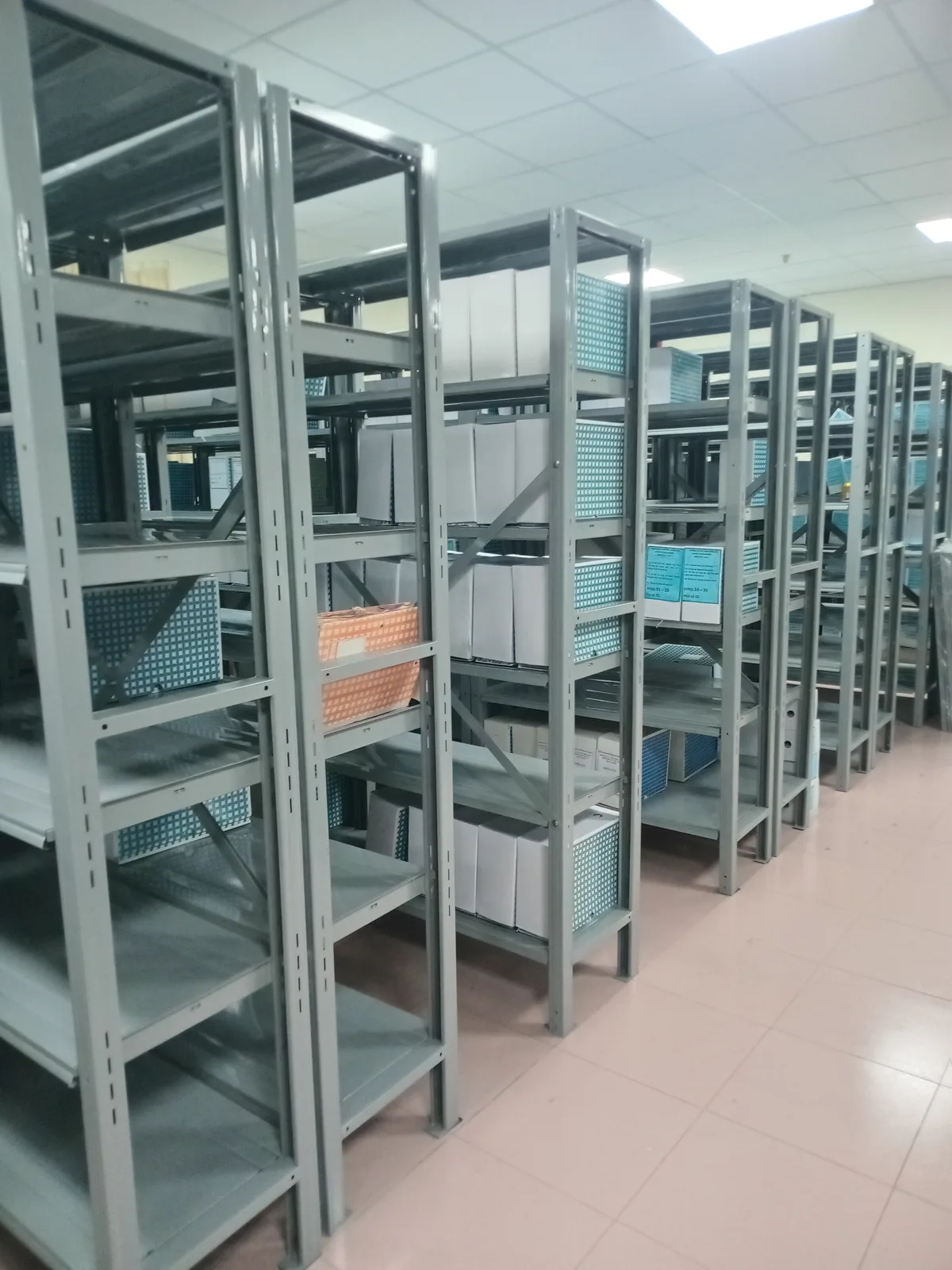
Modular shelving is optimal when the records room has controlled access, high records density, and records staff need to look up files frequently. Open shelving allows multiple rows, expansion of rows as records grow, and adjustment of tier spacing to match box sizes. This is the option with the highest capacity per m² among the three types if the room is already tightly controlled.
Illustrative example: a 40 m² records room fitted with open shelving in rows, each row 400 mm deep, with aisles between rows, typically holds considerably more boxes than placing closed steel cabinets over the same area, because cabinets need clearance to open their doors in front. The specific figure depends on room height, row length, and actual box size; you should send the room dimensions to receive a layout plan.
Việt POS Rack’s archival records shelving measures 1090 × 400 × 2000 mm (length × depth × height), with a 1000 mm bay and 6 shelves. The 400 mm depth is enough to place TCVN 9252 boxes upright — box depth 350 mm, height 250 mm, spine 125 mm — with the spine facing outward for easy lookup. A 1000 mm bay can hold multiple boxes along the spine; the exact number of boxes depends on the thickness of the records in each box, so the calculation below is only an estimate for budgeting purposes.
Estimate: if each TCVN 9252 box is about 125 mm thick along the spine and the 1000 mm bay is filled with boxes placed side by side, one tier is estimated to hold about 8 boxes; with 6 shelves, one bay is estimated to hold about 48 boxes. This is an estimate based on nominal dimensions, without deducting handling clearance and the actual thickness of the records inside the boxes. Buyers should send the actual number of boxes so the calculation can be redone according to the box size in use.
On expansion: modular shelving allows adding rows or shelves as records grow, without replacing the entire system. This is an advantage for records rooms that accumulate files over many years. See also how to calculate the number of records shelving for an archive to budget by shelf meter and floor area.
Steel records cabinets: lockable, low dust, lower capacity
Steel records cabinets suit confidential files, personnel records, or documents that need to be locked separately by each unit. Cabinets protect documents from dust and unauthorized access at the individual cabinet level, but capacity per m² is lower than open shelving because clearance for opening doors is required, and lookups are slower since each door must be opened.
Steel door cabinets are typically chosen when the room does not yet have tight access control, or when a department needs to keep records in its office. However, if the goal is to store a large volume of records that are due to be transferred to the archive, door cabinets will quickly run out of space and scatter records across many cabinets. For records rooms with access control under Article 10 of Decree 113/2025, cabinets should only be used as a supplement for confidential records, not as the main storage option.
Mobile records cabinets: high density, higher investment
Mobile shelving is suitable when the warehouse floor is very narrow but the volume of records is large, and simultaneous retrieval traffic is not high. The rail-mounted system allows rows to sit close together, saving aisle space, but requires a flat floor, a movement mechanism, and a larger investment budget than boltless shelving.
For a newly opened records warehouse, if there is not yet a need to maximize space compression, boltless shelving is usually a reasonable first step; it can be upgraded to a mobile system when records increase and the floor no longer has room for expansion. The page archive records storage shelving according to TCVN 9253:2012 presents technical requirements, load testing, and acceptance for reference when preparing procurement documents.
Detailed comparison of boltless record shelving, hinged steel cabinets, and mobile cabinets
The table below compares the three options according to five procurement criteria: capacity per m², retrieval speed, level of record protection, scalability, and access control conditions. Boltless shelving is best for capacity and retrieval; hinged cabinets are best for protecting each individual record unit; mobile cabinets are best for saving space when the floor is narrow.
| Criterion | Boltless record shelving | Hinged steel cabinets | Mobile record cabinets |
|---|---|---|---|
| Capacity per m² of floor | Best — many rows, no door-opening clearance needed | Low — requires door-opening clearance in front of the cabinet | High — rows sit close together on rails |
| Retrieval speed | Best — spines face outward, the whole row is visible | Slow — open each door, search within compartments | Medium — need to move the front row before retrieving |
| Protection from dust and unauthorized access | Depends on warehouse room control | Best — lock each cabinet | Locked by row or by compartment |
| Expansion when records increase | Best — add rows, add shelves | Limited — must buy additional cabinets | Difficult — depends on rails and floor |
| Access control conditions (Article 10 of Decree 113/2025) | Suitable when the warehouse already has access control and intrusion prevention | Used as a supplement for confidential records | Suitable for tightly controlled warehouses with few retrieval visits |
Which type to choose according to the records warehouse use case
The choice of type depends on the record type, volume, and access control conditions of the warehouse. Below are common situations and corresponding recommendations, with reasons for procurement staff to compare against their unit’s actual conditions.
Warehouse for records due for archival transfer, large volume, with access control: choose boltless record shelving. Reason: highest capacity per m², fast spine-based retrieval, expandable rows when records increase. Access control and intrusion prevention conditions under Article 10 of Decree 113/2025 are the basis for using open shelving instead of hinged cabinets.
Confidential records, personnel records, records pending destruction: use lockable steel cabinets, placed in a controlled storage room. Reason: each document unit needs to be locked and access restricted; cabinets meet the protection requirement at the individual cabinet level.
Very narrow floor space, many records, few simultaneous retrieval needs: consider mobile shelving. Reason: rows placed close together help maximize floor area, but a flat floor and a larger investment budget than boltless shelving are required.
Newly opened warehouse, accumulation rate of records not yet known: start with boltless shelving, add cabinets for confidential record groups. Reason: boltless shelving is flexible for adjusting shelf spacing and expanding rows, suitable for the initial phase before finalizing a long-term plan.
Pros and cons of each option
Each option has its own advantages and limitations. Boltless shelving is strong in capacity and retrieval but depends on storage room control; cabinets are strong in protection but have low capacity; mobile shelving saves space but investment and operation are more complex.
Boltless record shelving
- Pros: high capacity per m²; fast spine-based retrieval; adjustable shelf spacing; expandable rows as records grow; suitable for warehouses with access control.
- Cons: no locking of individual record units; confidential records require separate cabinets; depends on storage room control and intrusion prevention.
Steel record cabinets
- Pros: lockable per cabinet; limits dust; suitable for confidential and personnel records; can be placed in small offices.
- Cons: low capacity per m²; requires door opening clearance; slow retrieval; difficult to expand as records grow.
Mobile shelving
- Pros: high storage density in narrow floor space; rows placed close together save aisles; can be locked by row.
- Cons: larger investment; requires flat floor and rails; must move rows before retrieving records.
Specifications of Viet POS Rack archive shelving
Viet POS Rack archive shelving measures 1090 × 400 × 2000 mm, with a compartment depth of 1000 mm and 6 shelves. The 400 mm depth fits TCVN 9252 boxes placed upright with spines facing outward; the 1000 mm compartment allows multiple boxes to be arranged along the spine direction for easy retrieval.
The shelving is manufactured by Viet POS Rack — part of Viet Duc Tri Group Joint Stock Company — at the DT830 factory, Tan Duc Industrial Park, Tay Ninh. Ho Chi Minh City office: 158/50 Hoang Hoa Tham, Ward Seven. When placing a custom order, provide the number of boxes or meters of shelving, the storage room dimensions, and the box size in use so a layout and quote can be prepared. You can also refer to 6-tier record storage shelving 2 m high to compare capacity specifications and box arrangement.
Frequently asked questions
Can modular file shelving replace steel file cabinets?
Modular file shelving can replace wing-door steel cabinets provided the document storage area has access control and intrusion protection in accordance with Article 10 of Decree 113/2025. If there are still confidential records requiring separate locking, the wing-door cabinet should be kept for that group of records, and open shelving used for the volume of records due for transfer to archival storage.
How many TCVN 9252 boxes can one 1000 mm shelf bay hold?
Estimated based on nominal dimensions: TCVN 9252 boxes have a 125 mm spine, so a 1000 mm bay can hold about 8 boxes per tier; with 6 shelves, one bay is estimated to hold about 48 boxes. This is an estimate and does not deduct clearance for handling or the actual thickness of records inside the boxes; the actual number of boxes should be sent for recalculation.
When should mobile file cabinets be chosen instead of modular shelving?
Mobile file cabinets should be chosen when the storage floor area is very narrow, the volume of records is large, and simultaneous retrieval traffic is not high. Mobile cabinets require a flat floor, rails, and a larger investment budget than modular shelving; if the warehouse still has room to add more rows, modular shelving is usually a reasonable first step.
Is a 400 mm deep shelf sufficient for TCVN 9252 boxes placed upright?
Yes. TCVN 9252 boxes are 350 mm deep, 250 mm high, with a 125 mm spine; a 400 mm deep shelf allows boxes to be placed upright with the spine facing outward, which is convenient for retrieval. When ordering shelving, the actual box size in use should be confirmed so that tier spacing can be adjusted accordingly.
What information is needed to get a quote for purchasing modular file shelving?
It is necessary to provide the number of boxes or the number of linear meters of shelving, the dimensions of the storage room, and the box size in use. Việt POS Rack will prepare a layout and quote based on this information; the document shelving calculator can also be used to estimate before sending a request.
Need to choose between modular file shelving and steel file cabinets for a document storage area? Send the number of boxes or linear meters of shelving along with the storage room dimensions to Việt POS Rack via hotline 0796 700 777 or email info@vietposrack.vn to receive a layout plan and a quote based on the exact box size in use.
