

 Tiếng Việt
 中文 (Chinese)
 한국어
 日本語

.bp-product-grid .bp-product h4 a{color:#1e293b;text-decoration:none}
.bp-product-grid .bp-product .bp-price{color:#dc2626;font-weight:bold;font-size:13px;margin-bottom:6px}
.bp-product-grid .bp-product .bp-btn{display:block;text-align:center;background:#2563eb;color:#fff;padding:6px 8px;border-radius:4px;text-decoration:none;font-size:12px;margin-top:auto}
.bp-stats{display:grid;grid-template-columns:repeat(auto-fit,minmax(160px,1fr));gap:14px;margin:24px 0;text-align:center}
.bp-stats > div{background:#f8fafc;border-radius:8px;padding:18px 12px;border:1px solid #e2e8f0}
.bp-stats .bp-stat-num{font-size:32px;font-weight:bold;color:#2563eb;line-height:1.1;margin-bottom:4px}
.bp-stats .bp-stat-label{font-size:13px;color:#475569}
.bp-customer-box{background:#f1f5f9;border-radius:8px;padding:16px 20px;margin:20px 0;border-left:4px solid #475569}
.bp-customer-box strong{color:#1e293b}
.bp-testimonial{background:#fef9e7;border-left:4px solid #f59e0b;padding:20px 24px;margin:28px 0;border-radius:6px;font-style:italic;color:#78350f;font-size:16px;line-height:1.6}
.bp-testimonial cite{display:block;margin-top:12px;font-style:normal;color:#92400e;font-size:13px;font-weight:600}
.bp-verdict-box{background:#dcfce7;border-left:4px solid #16a34a;padding:14px 18px;margin:16px 0;border-radius:6px;color:#14532d}
.bp-verdict-box strong{color:#15803d}
.bp-coverage-table{width:100%;border-collapse:collapse;margin:24px 0;font-size:14px}
.bp-coverage-table th{background:#475569;color:#fff;padding:10px;text-align:left}
.bp-coverage-table td{padding:9px 10px;border-bottom:1px solid #e2e8f0}
.bp-policy-grid{display:grid;grid-template-columns:repeat(auto-fit,minmax(220px,1fr));gap:14px;margin:24px 0}
.bp-policy-grid > div{background:#f0f9ff;border:1px solid #bae6fd;border-radius:8px;padding:16px}
.bp-policy-grid h4{margin:0 0 8px;color:#0c4a6e}
.bp-policy-grid p{margin:0;color:#0369a1;font-size:14px}
.bp-glossary{width:100%;border-collapse:collapse;margin:20px 0;font-size:14px}
.bp-glossary th{background:#f1f5f9;color:#1e293b;padding:10px;text-align:left}
.bp-glossary td{padding:10px;border-bottom:1px solid #e2e8f0;vertical-align:top}
.bp-glossary tr:nth-child(even) td{background:#fafafa}
.bp-tldr{background:#f0f9ff;border:1px solid #bae6fd;border-radius:10px;padding:16px 20px;margin:20px 0 28px}
.bp-tldr-label{display:block;font-size:12px;font-weight:700;letter-spacing:.04em;text-transform:uppercase;color:#0369a1;margin-bottom:6px}
.bp-tldr p{margin:0;color:#0c4a6e;font-size:15px;line-height:1.6}
.bp-toc{background:#f8fafc;border:1px solid #e2e8f0;border-radius:10px;padding:16px 22px;margin:20px 0 28px}
.bp-toc-title{margin:0 0 8px;font-size:13px;font-weight:700;letter-spacing:.03em;text-transform:uppercase;color:#1e293b}
.bp-toc ul{margin:0;padding-left:20px;columns:1}
.bp-toc li{margin:4px 0}
.bp-toc a{color:#2563eb;text-decoration:none;font-size:14px}
.bp-toc a:hover{text-decoration:underline}.bp-stat-callout{background:linear-gradient(135deg,#1e293b 0%,#334155 100%);color:#fff;border-radius:10px;padding:22px 26px;margin:24px 0;text-align:center}
.bp-stat-callout .bp-stat-callout-num{font-size:40px;font-weight:800;line-height:1.1;color:#7dd3fc}
.bp-stat-callout .bp-stat-callout-label{font-size:14px;color:#cbd5e1;margin-top:6px}
.bp-hero{margin:0 0 28px;text-align:center}
.bp-hero img{width:100%;border-radius:12px;display:block;aspect-ratio:16/9;object-fit:cover}
.bp-inline-img{margin:24px 0;text-align:center}
.bp-inline-img img{width:100%;border-radius:8px;display:block;aspect-ratio:16/9;object-fit:cover}
.bp-inline-img figcaption{font-size:13px;color:#64748b;margin-top:8px;font-style:italic}
Steel shelving for office records is a steel-frame shelving system used to store records and documents by tier, replacing wooden cabinets in records rooms and archive warehouses. Three specifications determine whether the shelving lasts a long time or must be replaced early: the shelf depth relative to the storage boxes, the number of tiers relative to the ceiling height and the reach of the person retrieving records, and the load capacity of each shelf when paper boxes are fully loaded. Choosing wrong at the purchase stage often leads to boxes with excess space left behind, upper tiers that cannot be reached, or sagging shelves when fully loaded with records.
When buying steel shelving for office records, choose the shelf depth according to the storage box TCVN 9252:2012 (350 × 250 × 125 mm) placed upright with the spine facing outward, choose the number of tiers according to the ceiling height and the reach of the person retrieving records, and choose the load capacity according to the weight of the paper boxes when fully loaded. Viet POS Rack archive document shelving 1090 × 400 × 2000 mm, compartment inner width 1000 mm, 6 shelves is a configuration suitable for common office records warehouses.
Why should you replace wooden cabinets with steel shelving for office records?
Steel shelving for office records makes better use of ceiling height than upright wooden cabinets, allows tiers to be divided according to the exact size of storage boxes, and is easy to expand as the number of records increases. For the same floor area, steel shelving holds more meters of shelving than wooden cabinets of the same height, while also avoiding the termite problems of wood materials in storage warehouses.
When preparing a shelving purchase budget, administrative departments usually compare three options: upright wooden cabinets, steel cabinets with doors, and open multi-tier steel shelving. Wooden cabinets suit small offices but are hard to expand and cannot make use of ceiling height. Steel cabinets with closed doors protect records better, but the cost per meter of shelving is higher and opening the doors takes up aisle space. Open multi-tier steel shelving is the middle-ground choice: records are directly accessible, easy to arrange by box and by function, and shelves can be added easily when needed.
For storage warehouses where the number of records increases year by year, steel shelving allows purchasing in phases: the first phase installs the full frame and some shelves, and later phases only add shelves. This approach helps administration departments spread costs without having to replace the entire system. This is also why many project management boards investing in storage warehouses choose open steel shelving instead of closed cabinets.
How to choose shelf depth according to document storage boxes under TCVN 9252:2012?
Viet POS Rack Archive Document Shelf
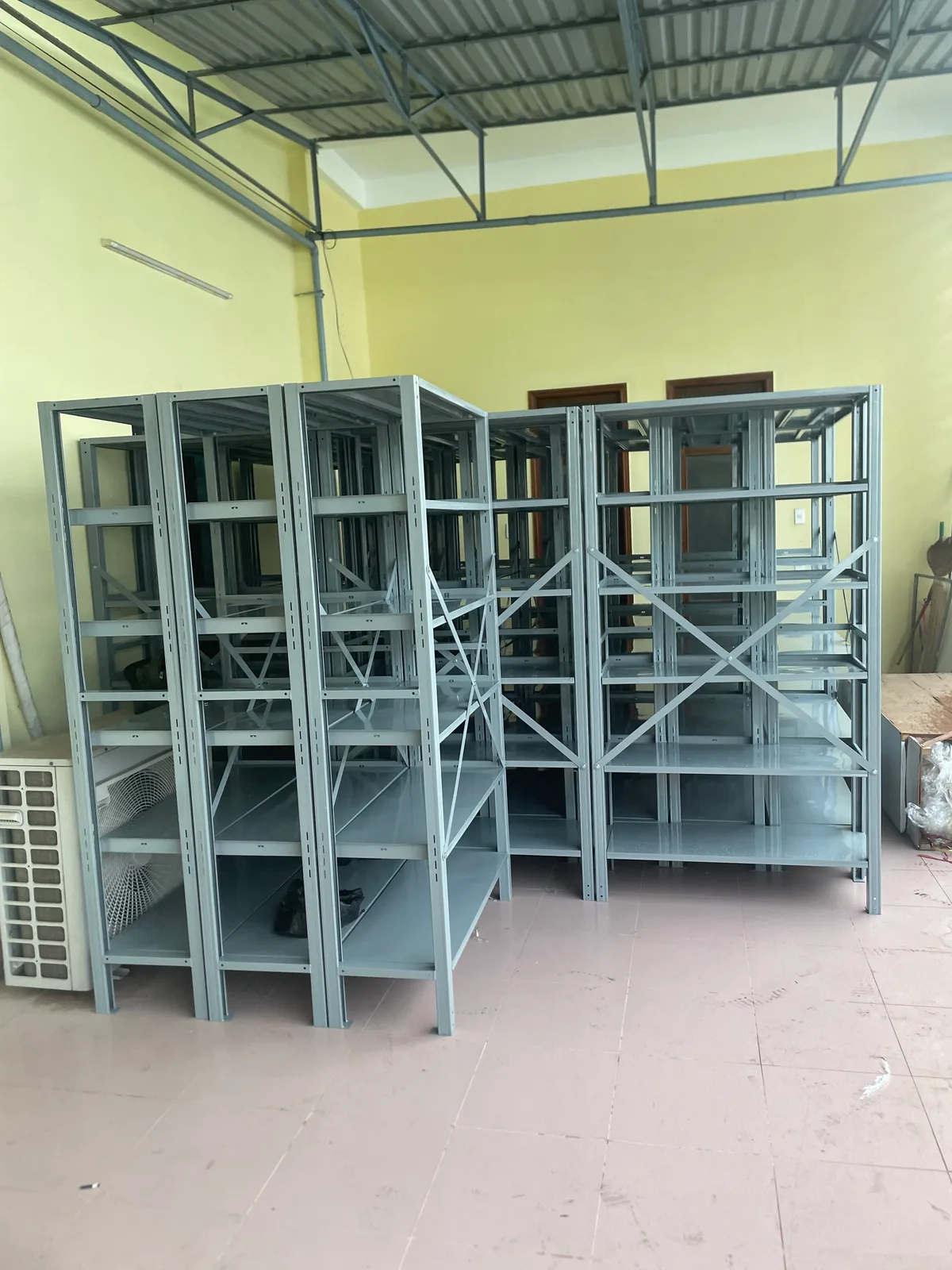
According to TCVN 9252:2012 Archive Document Storage Boxes, the box measures 350 × 250 × 125 mm with a tolerance of ±2 mm, and each side has a circular hole 30 mm in diameter for ventilation. When the box is placed upright with the 125 mm spine facing outward, the required depth is calculated along the 350 mm side, plus handling clearance. A 400 mm deep shelf accommodates this configuration and still leaves room for the hand when pulling out the box.
Estimated calculation for arranging a 400 mm deep shelf: the TCVN 9252:2012 box is placed upright with the spine facing outward, the 350 mm face runs along the shelf depth, and the remaining approximately 50 mm serves as handling clearance and air circulation. If the box is placed horizontally along the 250 mm side, a 400 mm deep shelf will have a lot of excess space at the back, wasting area and making it difficult to secure the box. Conversely, a 300 mm deep shelf is not enough for the box placed upright, forcing the box to be rotated and losing the ability to read the spine.
For common office file folders or ring binders, the actual depth of the storage item must be measured before installing the shelf. General principle: the shelf depth should be about 40–60 mm greater than the depth of the storage item to provide handling clearance, and should not be much greater because it will create dead space at the back. In the case of a narrow room, a shallower shelf can be used, but the box must be placed along the shallow direction and the spine labeled in the corresponding orientation.
Choosing the number of shelf tiers based on ceiling height and the reach of the person retrieving records
The number of shelf tiers depends on the warehouse ceiling height and the safe reach of the person retrieving records, and should not be chosen arbitrarily. The Viet POS Rack archive document shelf is 2000 mm high with 6 shelves, suitable for common warehouse ceilings and allowing a standing person to retrieve records from the upper tiers without a platform. When the ceiling is higher, additional shelf rows can be arranged or the number of shelves increased, but reach must be taken into account.
The tier spacing must be sufficient for the box height and for pulling the box out. With a TCVN 9252:2012 box 250 mm high, the tier spacing should be greater than the box height so the box does not have to be tilted when removed. If the tier spacing is too tight, the box will get stuck and the spine is easily torn; if too wide, the number of tiers decreases and shelf height is wasted.
Regarding reach, the top tiers should only hold records that are rarely looked up or records already boxed and awaiting destruction. The middle tiers are the main working zone, so they should be reserved for records that are frequently accessed. Arranging tiers by frequency of use helps reduce record retrieval time and limits unnecessary climbing.
Choosing shelf load capacity based on the weight of paper boxes when fully loaded
Shelf load capacity should be calculated based on the weight of paper boxes when fully loaded on each shelf board, not based on the weight of loose records. A shelf board 1000 mm long typically holds multiple boxes placed spine-first, and the total weight of these boxes is the basis for choosing the board load capacity. When purchasing a shelf, the expected number of boxes per board should be provided to the manufacturer so a suitable configuration can be advised.
Estimation calculation: if each box contains records of average weight and each board holds a certain number of boxes placed spine-first, the total board load equals the number of boxes multiplied by the average weight per box. This figure is used to compare against the board load capacity published by the manufacturer. Calculating by fully loaded paper boxes is more important than calculating by the number of records because paper boxes account for most of the weight and create an evenly distributed load on the board.
In addition to board load capacity, attention should be paid to how the load is distributed along the shelf height. Lower tiers bear a greater load than upper tiers within the same bay, so heavy boxes should be placed on low tiers and light boxes on high tiers. With multi-tier shelves, some boards should be left empty for rotating records when needed, avoiding the situation where every board is full and there is no room for rearrangement.
Viet POS Rack archival document shelf: specifications and reference configuration
The Viet POS Rack archival document shelf measures 1090 × 400 × 2000 mm (length × depth × height), with a compartment inner width of 1000 mm, 6 boards, manufactured by Viet Duc Tri Group Joint Stock Company at the DT830 factory – Tan Duc Industrial Park – Tay Ninh. This configuration is suitable for common office record storage when using TCVN 9252:2012 preservation boxes placed upright with the spine facing outward.
With a depth of 400 mm, the shelf fits the TCVN 9252:2012 box in the upright position and still leaves working clearance. The 1000 mm compartment inner width allows multiple boxes to be placed spine-first depending on box thickness; this is the basis for calculating the estimated number of boxes per board. The 2000 mm height with 6 boards suits common warehouse ceilings and the reach of the person retrieving records, while also being sufficient to arrange tier spacing according to box height.
The Viet POS Rack office in Ho Chi Minh City is located at 158/50 Hoang Hoa Tham, Ward Bay; the manufacturing factory is at DT830 – Tan Duc Industrial Park – Tay Ninh. When there is a need to purchase office record shelves, customers can send the number of boxes or the number of shelf meters and the storage room dimensions to receive advice on shelf arrangement and a quotation.
Comparison table of shelving configurations by records storage needs
The table below compares steel shelving configurations for office records by storage needs, helping administration departments and project management boards invest in warehouse shelving choose the right configuration right from the purchasing stage. The configurations differ mainly in depth, number of tiers, and aisle layout; it is not always necessary to choose the largest configuration for every room.
| Configuration | Reference dimensions | Suitable for | Purchasing notes |
|---|---|---|---|
| Standard 6-tier shelving | 1090 × 400 × 2000 mm, compartment inner width 1000 mm | Office records warehouses using TCVN 9252:2012 boxes | Place boxes upright with spines facing outward |
| Shallow shelving for record binders | Depth less than 400 mm | Narrow offices, thin binder-type records | Measure the depth of the storage media before ordering |
| Shelving with additional tiers | Same frame, more tiers | Warehouses with needs growing year by year | Consider reach height when adding tiers |
| Shelving combined with narrow aisles | Same depth, narrower aisles | Warehouse rooms with limited floor area | Ensure aisles are wide enough for operation |
The figures in the table are references for comparison and do not replace actual measurement of the warehouse room. Before purchasing, you should draw a floor plan of the room with length, width, door positions, and aisle directions, then send it to the manufacturer for shelving layout advice.
Calculation for estimating the number of boxes and meters of shelving to buy
To estimate the number of shelves to buy, divide the total number of boxes by the number of boxes that fit on each tier, then divide by the number of tiers per shelf. This calculation is only an estimate because it also depends on box thickness, arrangement, and operating clearance. The result is used for initial budgeting, not for finalizing orders in place of an actual survey.
Illustrative example: a warehouse has a number of boxes to store, each shelf tier with a 1000 mm inner compartment width fits a certain number of boxes by spine, and each shelf has 6 tiers. From this, the estimated number of shelves and the corresponding meters of shelving can be calculated. When sending a quotation request, you should provide the actual number of boxes or the expected meters of shelving so the manufacturer can advise on a suitable configuration.
For storage warehouses with many types of records of different sizes, they should be separated into groups by box size and arranged on separate shelving for each group. This helps avoid shelving that is too deep for small boxes or too shallow for large boxes. You can also refer to how to calculate the number of records shelves for storage warehouses per Decree 113/2025 to cross-check the calculation method.
Common mistakes when buying steel shelving for office records
The three most common mistakes when buying steel shelving for office records are choosing shelves that are too deep or too shallow for the boxes, choosing shelves without bracing, and placing shelves close to water sources. All three lead to long-lasting consequences: wasted space, shelves that are unstable when fully loaded with records, and records that become damp and moldy. Identifying these mistakes early helps avoid having to replace the shelving after only a few years of use.
- Shelves too deep for the boxes: boxes get pushed deep inside, making spines hard to read and boxes hard to pull out; dead space forms at the back of the shelf.
- Shelves too shallow for the boxes: boxes cannot stand upright and must be turned sideways, losing spine readability and making them easy to drop when retrieved.
- Shelves without bracing: the shelf frame is less stable when fully loaded with records, prone to wobbling and shifting over time.
- Placing shelves close to water sources: records absorb moisture, becoming moldy and damaged; shelves should be positioned away from washing areas, water pipes, and windows that are frequently damp.
- Choosing the number of tiers by guesswork: upper tiers exceed reach, forcing people to climb or leaving tiers empty.
To limit the above mistakes, you should measure the actual dimensions of the storage boxes and measure the ceiling height and aisle width before ordering shelving. For long-term archived records, you can also refer to the technical requirements in archive document storage shelving according to TCVN 9253:2012: Technical requirements, load testing & acceptance to cross-check the relevant standards.
The process of buying office record shelving and installing it in the warehouse
The process of buying office record shelving consists of the following steps: surveying the storage room, choosing the shelving configuration, sending a quotation request, confirming the order, installing, and acceptance. Surveying before purchase helps determine the correct depth, number of tiers, and required meters of shelving, avoiding returns or additions after the shelving has been installed.
- Survey the storage room: measure the length, width, ceiling height, door positions, aisles, and sources of moisture.
- Measure the media: measure the actual dimensions of the storage boxes or record covers to choose the shelf depth.
- Estimate the number of boxes and meters of shelving: use estimation calculations to prepare an initial budget.
- Send a quotation request: provide the number of boxes or meters of shelving, the storage room dimensions, and the floor plan to receive layout advice.
- Confirm the configuration and place the order: finalize the depth, number of tiers, number of shelf boards, and installation plan.
- Install and accept: check the frame, shelf boards, bracing, and stability before putting the shelving into use.
During installation, shelving should be arranged along the main aisle and kept at a distance from walls for easy cleaning and inspection. For storage warehouses with many rows of shelving, rows and shelf boards should be numbered to manage records by location.
Frequently asked questions when buying steel shelving for office records
This section answers frequently asked questions from records officers, office managers, and facilities departments when purchasing steel shelving for office records. The answers focus on dimensions, number of tiers, load capacity, and how to submit a quotation request.
What depth should be chosen for steel shelving for office records?
The shelf depth should be chosen based on the actual dimensions of the storage media. For TCVN 9252:2012 storage boxes measuring 350 × 250 × 125 mm, placing the box upright with the 125 mm spine facing outward requires a depth calculated along the 350 mm side plus handling clearance; a 400 mm deep shelf meets this configuration. If thinner record binders are used, a shallower shelf can be chosen, but measurements must be taken before ordering.
How many tiers should record shelving have?
The number of tiers depends on ceiling height and the reach of the person retrieving records. Viet POS Rack archive document shelving is 2000 mm high with 6 shelf levels, suitable for common warehouse ceilings and allowing records to be retrieved from upper tiers without a platform. When the ceiling is higher, the number of shelf levels can be increased, but reach and tier spacing must be recalculated based on box height.
How is the required shelf load capacity calculated?
Shelf load capacity is calculated based on the weight of cardboard boxes when each shelf level is fully loaded. The number of boxes per shelf level and the average weight per box should be estimated, then compared with the shelf level load capacity published by the manufacturer. The expected number of boxes should be provided to the manufacturer to receive advice on a suitable configuration.
Are shelf braces needed?
Yes. Braces help keep the shelf frame stable when fully loaded with records and reduce shaking during use. Unbraced shelving tends to become misaligned over time, especially when the shelving is tall and loaded across multiple tiers. When purchasing, the bracing configuration should be confirmed in the manufacturer’s drawings or technical specifications.
Where should shelving be placed in the storage room?
Shelving should be placed away from water sources, washing areas, and windows that are frequently damp. Arrange shelving along the main aisle and keep a distance from walls for easy cleaning and inspection. For warehouses with multiple shelving rows, rows and shelf levels should be numbered to manage records by location.
What information is needed to quote office record shelving?
To receive a quotation, provide the expected number of boxes or linear meters of shelving, the storage room dimensions, and the layout plan. Viet POS Rack receives information via hotline 0796 700 777 or email info@vietposrack.vn for shelving layout advice and quotations. You can also refer to the 2026 technical standard guide for selecting selective racking for industrial warehouses to cross-check the parameter selection method.
How does steel shelving for office records differ from industrial warehouse shelving?
Office document steel shelving typically has a lower shelf load capacity and dimensions suited to office information carriers, while industrial warehouse shelving is used for pallets of goods with a much higher load capacity. When a storage warehouse combines both documents and goods, the areas should be separated and a separate shelving configuration selected for each area. You can refer to structure of selective industrial warehouse shelving: principles & applications for comparison.
To receive shelving layout consultation and a quote for office document steel shelving, please send the number of boxes or meters of shelving and the warehouse room dimensions to Viet POS Rack via hotline 0796 700 777 or email info@vietposrack.vn. You can also refer to Selective Pallet Rack 2026: optimal density solution for 3PL if the storage warehouse combines pallet goods.
