

 Tiếng Việt
 中文 (Chinese)
 한국어
한국어 日本語
日本語When managing a warehouse, it is essential to carefully consider the shelving systems you install. This decision can significantly impact logistics operations in any business, helping to improve efficiency, create a safer working environment, and reduce storage costs if you choose the right solution. However, selecting unsuitable shelving for your warehouse can result in an inefficient storage and operations system, and even create a work environment with potential safety risks.
In today’s “on-demand” environment, effective inventory management is crucial to streamlining warehouse operations. Ultimately, your warehouse can only be efficient if your storage solution keeps up. When goods are not neatly organized, and are difficult to retrieve or catalog, operators will struggle to maintain productivity and motivation, while managers will find it harder to plan effectively.
Therefore, if you are looking for the best shelving and storage solution for your warehouse, here are some tips to help you make the right choice.
Detailed Tips for Choosing the Optimal Warehouse Shelving:
1. Identify the Type of Goods and Storage Needs:
This may seem obvious, but there are currently many different shelving system options and varieties available on the market. Below is a list of several shelving systems along with their key unique selling points (USPs), making them suitable for specific requirements.
- Classify Goods: Categorize goods by size, weight, and characteristics (fragile, flammable, etc.) to choose the most suitable shelving type.
- Determine Inbound/Outbound Frequency:Goods with high turnover should be stored in easily accessible locations, while less frequently used items can be stored in more distant positions.
- Determine Quantity and Storage Space: Calculate the total area required to store the goods and select shelving that can meet this capacity.
- Identify Load-Bearing Capacity: Ensure the shelves can support the maximum weight of the goods, ideally adding 10–20% extra capacity for safety.
2. Choose the Appropriate Shelving Type:
Selective Racking
Suitable for various types of goods, easy to access and manage, ideal for warehouses with a wide range of products and different inbound/outbound frequencies. This type of warehouse racking is designed to store goods on pallets and is particularly well-suited for facilities handling diverse products with varying turnover rates. The key advantage of Selective Racking is its ability to provide direct access to each pallet, allowing easy management and retrieval without affecting other pallets.


Double Deep Racking
Optimizes warehouse space, suitable for goods in large quantities with little variation, but offers less flexible access. This type of warehouse racking is designed to maximize storage capacity by holding two pallets in each position—one in the front and one in the back. This arrangement increases storage density, making it particularly suitable for warehouses with large volumes of goods and minimal changes in product types. However, it may reduce accessibility, as retrieving items from the back can be more challenging.
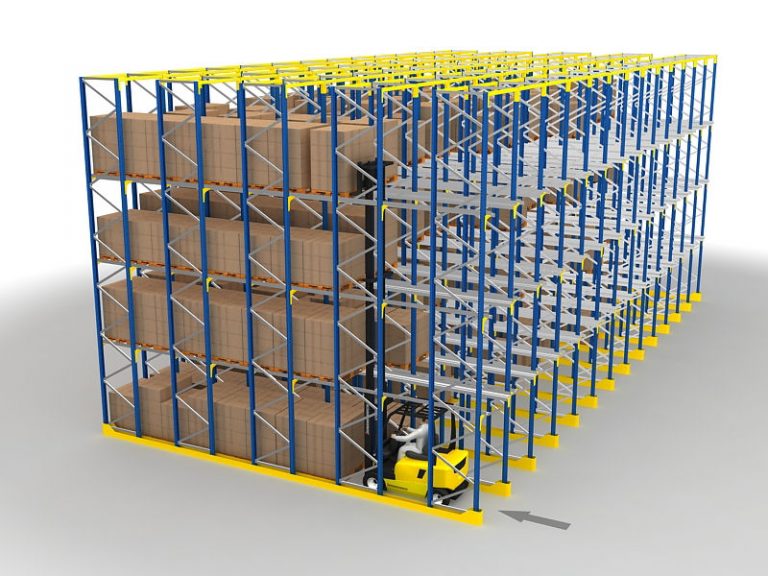
Drive-In Racking
Maximizes space utilization, suitable for uniform goods in large quantities, but offers the least accessibility. Drive-In Racking is a type of heavy-duty warehouse racking designed to optimize storage space, making it especially suitable for storing large volumes of identical goods. However, compared to other racking types, Drive-In Racking provides the lowest level of accessibility.

Cantilever Racking
It is a type of warehouse racking specifically designed to store long, bulky, and irregularly sized items such as steel pipes, timber, boards, and more. A key feature of Cantilever Racking is the absence of front columns, which makes loading and unloading much easier, especially for long and heavy goods.
Mezzanine Racking
Mezzanine Racking, also known as steel platform racking, is a combination of storage racking and a working platform, designed to increase the warehouse’s storage capacity. It inherits all the advantages of both racking and flooring while minimizing the drawbacks of using each separately.

3. Factors to Consider When Choosing a Warehouse Racking System
Each application has its own specific requirements, demanding different racking systems to ensure that storage solutions meet operational goals. Below are some of the key factors to keep in mind when selecting a pallet racking system:
3.1. Product Flow and Materials
Product flow refers to how inventory moves throughout the warehouse. Every stage of the flow—from receiving and storage to picking and shipping—requires space-saving solutions. How a warehouse optimizes product flow depends on its inventory management method and facility layout.
Two common inventory methods are First-In, First-Out (FIFO) and Last-In, First-Out (LIFO). Certain pallet racking systems are better suited for FIFO inventory scenarios, while others work more effectively with LIFO. Understanding how product flow impacts inventory and material storage will help businesses choose the ideal pallet racking system for their operations.
3.2. Warehouse Layout
The warehouse layout also determines the ideal pallet racking system. Distribution centers often have limited floor space, so racking systems must be optimized accordingly. Vertical space is an important factor, as it affects the height of the warehouse storage system.
Pallet racking suppliers bring expertise and personalized consultation to help businesses select a racking configuration that matches their specific application and operational requirements.
3.3. Pallet Characteristics (Weight & Dimensions)
The size, shape, quantity, and weight of the inventory to be stored directly affect the type of material handling and storage solution a warehouse can use. The racking space must accommodate the necessary dimensions to store palletized goods efficiently.
Rack depth has a significant impact on storage density. Double-deep pallet racking allows warehouse staff to store two pallets in depth, while single-deep racking only accommodates one pallet.
3.4. Budget
The budget of a warehouse or distribution center is an important factor in determining which pallet racking system to use. While budget plays a key role in meeting financial goals, cheaper options may not always be the best choice.
Structural steel racking may have a higher initial cost compared to other racking systems, but the return on investment can be substantial. Structural steel racks offer superior durability and strength, with a much longer lifespan than alternatives such as roll-formed racks.
3.5. Safety
Employee safety is a top priority in any warehouse. A storage system with a solid, durable structure designed to suit the location and intended use will provide optimal safety for operations and warehouse staff.
Pallet rack suppliers construct their systems from steel to ensure they can withstand various materials and load capacities. The rack design should allow clearance for sprinklers and fire suppression systems, as well as comply with other local and state regulations.
3.6. Accessibility
Warehouse staff and operators must be able to access pallets and materials stored on the racking system quickly and efficiently. Two key factors to consider for accessibility are the type of forklift used and the width of the aisles.
When choosing a warehouse racking system, take into account the limitations of existing material handling equipment. Some types of equipment can handle inventory of varying heights and weights more effectively. For example, a double-deep selective racking system requires a high-reach forklift.
3.7. Flexibility
Many warehouses use multiple racking systems in their operations to accommodate products of varying weights and sizes. Using versatile pallet racking allows warehouses to store a wide range of products and applications with a single solution. For instance, warehouses may combine selective racking, drive-in racking, push-back racking, or other types to optimize efficiency and diversify inventory storage and material handling.
3.8. Customized Solutions
After considering budget, space, accessibility, and product flow requirements, a business may determine that a customized racking system is the ideal solution. A supplier that designs custom storage racks tailored to the physical layout, provides the necessary storage space for expansion, and optimizes accessibility will help streamline inventory management.
4. Optimizing Space and Product Flow:
-
Utilize warehouse height: Use high-rise racking to increase storage capacity, ensuring safety and accessibility.
-
Create wide aisles: Ensure aisles are wide enough for forklifts and staff to move easily, avoiding congestion.
-
Segment storage areas: Divide the warehouse into distinct zones for different product types to improve management and speed up retrieval.
-
Use a labeling system: Clearly label each zone and storage position to help staff quickly identify and pick items.
-
Apply FIFO/LIFO principles: Store goods according to First-In, First-Out (FIFO) or Last-In, First-Out (LIFO) principles, depending on product characteristics.

5. Ensuring Warehouse Safety and Management:
-
Comply with safety regulations: Ensure the safety of both employees and goods, avoiding situations where goods obstruct aisles, block camera views, or hinder ventilation systems.
-
Train employees: Provide training on workflows, occupational safety, and the proper use of warehouse equipment.
-
Conduct regular inventory checks: Perform frequent stocktaking to stay updated on inventory status and prevent losses.
-
Plan for expansion: Anticipate future warehouse expansion and choose racking systems that can be easily extended or modified.
👉 Viet Pos Rack offers a wide range of models, sizes, and load capacities for every racking type, ready to provide the most optimal solutions for any warehouse model.
