

 Tiếng Việt
 中文 (Chinese)
 한국어
한국어 日本語
日本語In today’s era of rapid digital transformation, businesses in logistics, e-commerce, manufacturing, and distribution are under increasing pressure to optimize warehouse operations. High labor costs, rising order volumes, and the demand for fast, accurate processing have pushed organizations to adopt smarter storage technologies. Among the most advanced solutions available today is the Robot Shuttle Rack System, a fully automated high-density storage system powered by intelligent robotic shuttles.
So, what exactly is a Robot Shuttle Rack? How does it work, and why is it becoming a preferred choice for modern warehouses? This article provides a comprehensive, SEO-optimized explanation suitable for professional readers.
1. What Is a Robot Shuttle Rack System?
A Robot Shuttle Rack is an automated storage and retrieval system (AS/RS) that uses robotic shuttles to transport pallets or totes within multi-level racking structures. Instead of relying on forklifts or manual labor, the system leverages high-speed robots to move goods efficiently and accurately inside the warehouse.
A standard Robot Shuttle Rack system typically includes:
-
Multi-level racking structure
-
Robotic shuttles that move horizontally along rails
-
Vertical lift systems for moving shuttles and goods between levels
-
Inbound and outbound workstations
-
Warehouse Control System (WCS) and Warehouse Management System (WMS) software
This system is designed for high-throughput operations and large facilities where speed, accuracy, and storage density are critical.
Other names used for this technology include:
-
Multi-Level Shuttle AS/RS
-
High-Density Shuttle Storage System
-
Automated Shuttle Racking
Regardless of the terminology, the principle remains the same: robots automate the storage and retrieval process to maximize efficiency.
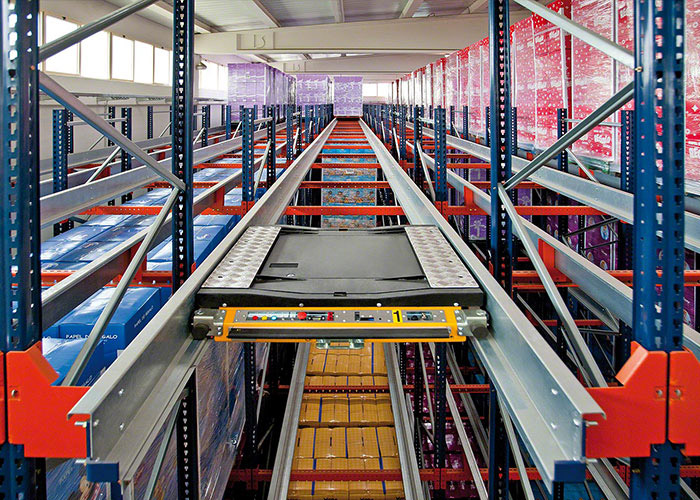
What Is a Robot Shuttle Rack System?
2. Key Components of a Robot Shuttle Rack System
A complete system consists of several main components working together:
• Racking Structure
The racking system is engineered with multiple lanes and levels, allowing maximum use of warehouse height and floor area.
• Robotic Shuttle
A compact, high-speed robot that moves horizontally along guide rails inside each rack level.
Function: retrieves or stores totes/pallets within each lane.
• Vertical Lifts (Lifting Platforms)
These devices move goods and shuttles between different levels, enabling seamless multi-tier operations.
• Conveyor System for Inbound/Outbound
Conveyors deliver goods to and from the racking lanes for automated processing.
• Central Control Software (WMS/WCS)
Software tracks inventory in real time, assigns tasks, schedules robot movement, and optimizes workflow.
Together, these elements create a highly efficient, coordinated warehouse automation system.
3. How Does a Robot Shuttle Rack Work?
The Robot Shuttle Rack operates through a synchronized process involving software, robots, and lifting equipment. Its core workflow includes:
Step 1: Goods Received (Inbound)
Goods are placed on pallets or totes and delivered to the inbound station.
Step 2: Vertical Lift Assigns Storage Level
Based on rules set in the WMS — such as FIFO, product type, storage conditions, turnover rate, and space availability — the lift transports the load to an assigned level.
Step 3: Shuttle Transfers Goods into Storage
The robotic shuttle receives the item from the lift and travels along the lane to deposit it into its designated slot.
Step 4: Retrieval for Outbound
When items need to be picked, the system sends a task to the shuttle:
-
The shuttle retrieves the pallet/tote
-
Moves it to the lift
-
The lift transports it down to the outbound station
-
The goods are transferred onto conveyors or directly to picking stations
Step 5: Real-Time Data Update
Every movement—storage, retrieval, transport—is automatically recorded in the system. Inventory accuracy remains extremely high, reducing manual counting and errors.
This automated workflow ensures speed, precision, and continuous operation with minimal human intervention.
4. Key Benefits of a Robot Shuttle Rack System
4.1. Extremely High Storage Density
By significantly reducing the number of aisles and maximizing vertical space, the system increases warehouse capacity by 3 to 4 times compared to conventional racking.
Benefits include:
-
Optimized cubic space
-
More storage positions within the same footprint
-
Best solution for warehouses with high land costs
This makes it ideal for large distribution centers and high-value storage facilities.
4.2. Superior Throughput and Speed
Robot shuttles move at high speeds and allow multiple robots to operate on different levels simultaneously. This enables:
-
Faster inbound and outbound flow
-
Reduced order processing time
-
Higher efficiency during peak hours
-
Continuous 24/7 operation
For businesses prioritizing order accuracy and speed—such as e-commerce and FMCG—this system delivers exceptional performance.
4.3. Reduced Labor Costs and Fewer Human Errors
Automation eliminates many labor-intensive tasks, resulting in:
-
Fewer forklift operators
-
Lower risk of product damage
-
Minimal picking mistakes
-
Reduced accidents in warehouse aisles
By cutting down manual processes, businesses also reduce training costs and improve workplace safety.
4.4. Real-Time Visibility and Inventory Accuracy
The WMS/WCS ensures:
-
Real-time tracking of goods
-
Accurate inventory levels
-
Immediate reporting for audits and forecasting
-
Visibility into storage positions and movement history
-
Integration with ERP, OMS, and other business systems
This level of transparency greatly enhances operational efficiency.
4.5. Higher Safety for Workers and Goods
Since most storage and retrieval operations are automated:
-
Forklift traffic decreases significantly
-
Accidents and collisions are minimized
-
Damage to racks and goods is reduced
The warehouse becomes safer, cleaner, and more organized.
4.6. Scalable and Flexible for Future Growth
A major advantage of Robot Shuttle Rack systems is scalability. Businesses can expand capacity simply by:
-
Adding more robotic shuttles
-
Increasing the number of rack levels
-
Extending lane length
-
Adding additional lifts
This flexibility supports long-term development without needing major remodels.
Conclusion
Robot Shuttle Rack systems represent a breakthrough in warehouse automation, combining robotic technology, smart software, and high-density storage design. With exceptional speed, accuracy, and scalability, the system helps businesses:
-
Increase warehouse capacity
-
Improve throughput
-
Reduce labor and operational costs
-
Enhance inventory visibility
-
Strengthen safety and efficiency
As demands for fast and reliable order fulfillment continue to grow, Robot Shuttle Rack technology is becoming a key solution in the digital transformation of modern warehouses.
VietPos Rack is a leading manufacturer and provider of warehouse racking systems and automation solutions in Vietnam. With extensive experience and advanced production capabilities, VietPos Rack specializes in:
-
Robot Shuttle Rack systems
-
Automated AS/RS solutions
-
Heavy-duty, selective, drive-in, and mezzanine racking
-
Custom warehouse optimization services
-
Full-service design, manufacturing, and installation
VietPos Rack is committed to delivering high-quality, reliable, and efficient storage solutions that help businesses increase productivity, reduce costs, and modernize their warehouse operations.
